I am Jughead; We are Jughead

Thanksgiving Day, somewhere in the mid-1980s: Making a living as an actor in NYC during the time of Andrew Lloyd Webber is a daunting task, especially if you’re gawky looking and not much of a song-and-dance man.  Other than the actual living you’re making as a waiter/bartender/cabbie, you take some interesting side jobs just to keep your acting chops sharp.

I fell into a circuit of party performers, folks in and out of show-biz who hit on the private/corporate party circuit during the time of Wall Street’s crazy years.  We would take on personas and make crazy costumes and perform all manner of carny tricks – fortune telling, fire eating, tightrope walking, juggling –  at bar mitzvahs, sales meetings, corporate holiday parties, you name it.  We were paid crazy amounts of cash and many of the performers abandoned their “legit” pursuits of acting and jumped into this area full time.  Not me, I was trying to keep my purity.  But money is money and the rent is always due.
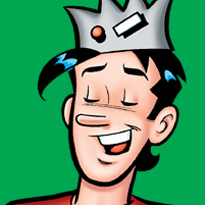
jughead

So I got a call from a guy from the circuit the week before Thanksgiving who said that he had the rights to the Archie Gang of Riverdale and they typically march in the Macy’s Parade, but this year, neither his Jughead or Reggie could make it and was I interested in being Jughead?  Ok, I’m curious, am I holding one of the balloons?  Am I doing something like the Renaissance Festival and interacting with the crowds?  I had just scored a good agent and we’re trying to put a career together, I don’t want to jeopardize my chance to play Hamlet for Joe Papp by bouncing down Broadway dressed up like, well…Jughead.  But I found we’d be wearing these huge rubber heads of the characters and dressed similarly as them: Archie would have a pullover sweater with an “R” on the front (for Riverdale).  And he had a sweater for me to wear, Jughead’s signature long-sleeve grey pull over mounted with a big “S” (for Stupid?).  We’d be joined by Betty and Veronica and all we had to do is walk in line with each other the entire length of the parade route and wave to the crowd.  The money was right, cash at the end of the parade, and no one knows that its me?  I’ve been following this group of teen sensations since I learned to read.  Hell yeah, I’m gonna march in the Macy’s Thanksgiving Day Parade, bitches!  I AM JUGHEAD.

Like any good actor, I do my prep work and research.  I stopped by the local bodega and picked up a couple Archie comic books, carefully scanning them first to make sure Jughead had a healthy role in each (Reggie had a way of taking over in those days) and spent a few hours understanding Jughead: besides eating, what did he like? What was his upbringing, did he have siblings?  Did he really not like Ethel or was he just playing her?  What was his relationship to his father?  Was that slouch because of his personality or was it a physical limitation?  An actor needs to know these things if he is to really be that character.  Also, I had done a fair amount of mask and mime work in commedia dell’ arte, clowning and Greek drama, so wearing a face covering was a different form of performance, much more about matching the body to the limitations of the mask in a more physically demanding style.  Like any acting job, I’m both excited and nervous the night before and make a few quick calls to family and friends to alert them to watch before resting up.
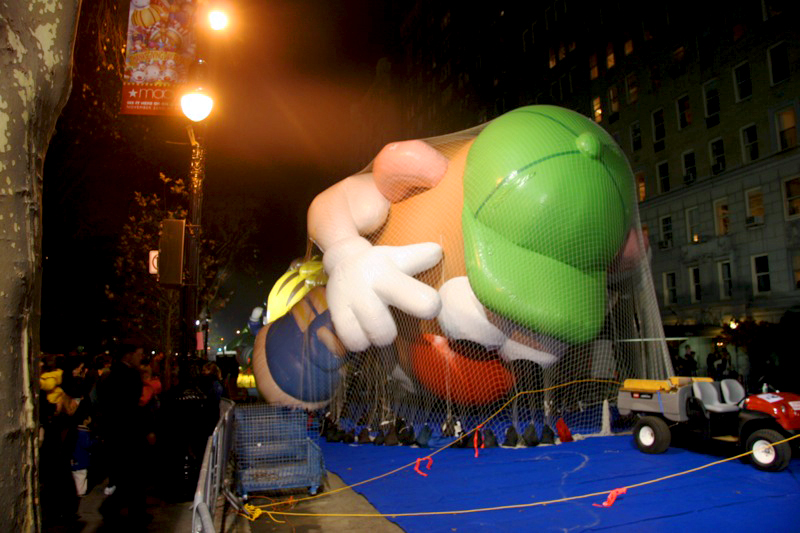
macys balloon1

I arrive on Columbus and 96th about 7:30 that morning and its a party, hundreds and hundreds of musicians, dancers, marchers, balloon wranglers stretching over to Central Park West where the parade route begins.  I’m wearing a pair of Chuck Taylors on my feet and black jeans and I’m introduced to “Betty” and “Veronica”, each dressed in their doppelganger’s signature style, and “Archie” has those crazy orange plaid pants on.  Apparently, he couldn’t cop a Reggie this late in the game, so its going to be just the four of us.  Archie is really Bill, the owner of the rights to the costume heads.  I met Bill a few times on the circuit, he’s an okay guy, not much of a personality and, I found out later, not actually a performer.  He was a business guy, saw all of this party stuff as a business opportunity: he had others make the costumes and sometimes perform in them, and he would “perform” at events that he wanted to monitor.  Which explained his lackluster approach to whatever he did, truly an uninspiring guy.  But right now, he’s my boss and he’s my best friend Archie and he huddles us around him prior to the start with the rules: “Listen, we keep together in a line, Jughead and Betty on the outside, Veronica and me on the inside.  We make sure we stay right behind the marching band in front of us.  All we do is wave, just walk and wave.  We can’t talk to each other, you won’t be able to hear, so don’t try to talk to each other.  Do not take off the head, you have to keep it on no matter what, so don’t sneeze.  When we get past Macy’s, make a right on 32nd street and then we can take them off.  When I get them back into the plastic bag, I’ll give you each a check.”

I was staring deep into Jughead’s big rubber eyes.  The mask and mime work I did taught me to understand the silent “voice” behind the mask, and that voice becomes the sound coming from the rest of your body.  The mask will tell you how you are to move, how to interact, whether or not you’re shy or outward, healthy or ill.  Be the mask.  Be Jughead.  Jughead has a look about him of sincere and permanent “whatever”.  He fears nothing because he is above mere human travails.  Jughead is beyond irony and has little interest in what you say about him.  Jughead knows everything is going to work out in the end.  Jughead is the epitome of cool.  I am Jughead.

We mount them up, get used to the hollow emptiness of our voices inside, and line up behind the Watchung High School Marching Band and Drum Corp.  The great balloons of Macy’s parades are silently floating above our heads, tethered down by their human guides, silently waiting.  Bands are tuned up and making last minute head gear adjustments, flags are being positioned just right.  At precisely 9:00 am, the Master of Ceremonies, dressed like P.T. Barnum, blows his whistle.  The bands begin to play and the long train of Macy’s Thanksgiving Parade begins its march down Central Park West toward its flagship store on 34th Street.  I’m excited as hell.

It all goes pretty smoothly for the first few blocks, except Archie wants us all to hold hands as we walk and I’m not excited about that.  Nothing I know about Jughead says he’s holding anyone’s hand and so after a few blocks I sort of casually lose connection with Archie and I can see Veronica’s done the same thing.  Jughead is an absolute independent, dude, Jughead’s his own man, he does not hold hands.  The crowd’s are excited to see us in the upper stretches of the Nineties and Eighties and as we get closer to Columbus Circle, I can see ahead of me the enormity of what this parade is about: even through the rubber head, I can hear the cheering and shouts of the crowd as each of the balloons passes by.  Now I’m kicking into full Jughead mode and have adopted his signature lean back.  I cock my head to the left and wave at the crowd, they respond back with cheers.  I walk a little further, cock my head again to the crowd with a wave, and they respond in kind.  I have made the connection, I know where Jughead lives: Jughead is a man of the people.  The people love Jughead and Jughead loves them back.

Around 75th Street, I get a touch on my right arm.  “Don’t do that”, says Archie in a small but strained voice rolling around in a big rubber dome.
“Don’t do what?”
“That, don’t do that.  That walk.  That’s not Jughead.”
“You’re kidding me right?”
“No, I’m not, don’t do that, that’s not Jughead.”
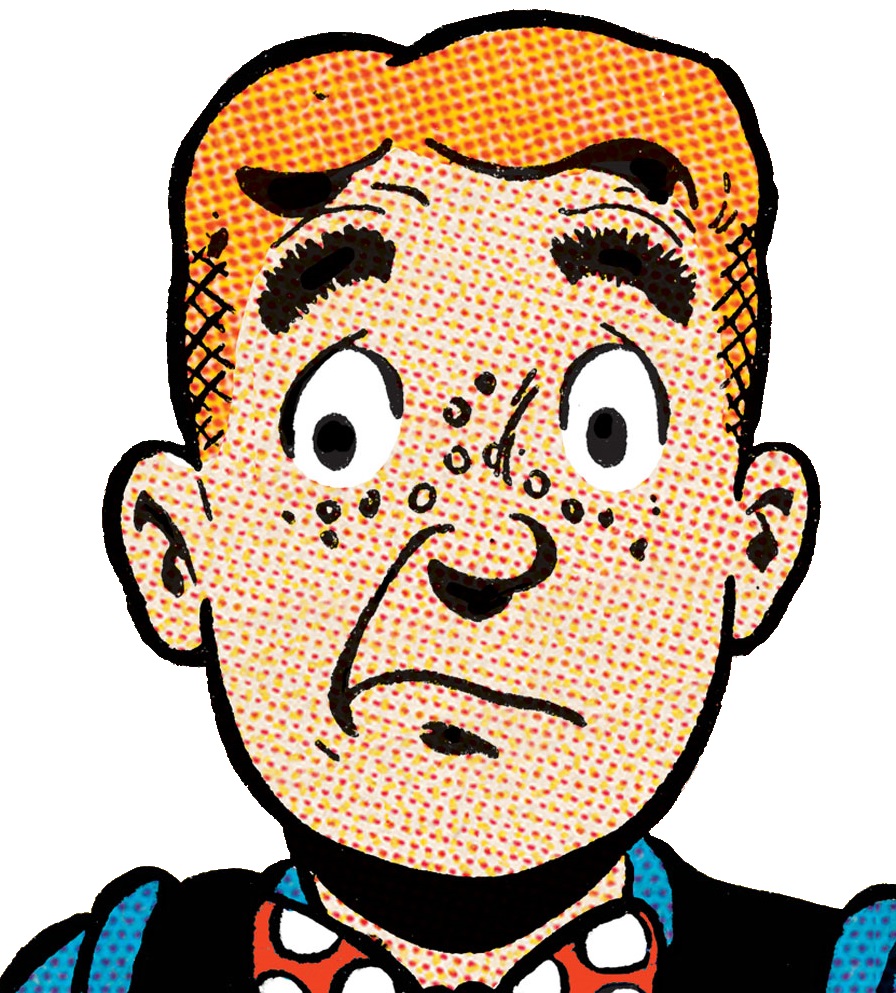
Archie 0

Alright, so this is screwed up.  I’m marching down a Manhattan street in the biggest event of the year wearing a rubber head and the guy next to me says I’m not doing it correctly.  I want to be a good cast member and he’s the one paying me, so for a few blocks through Columbus Circle around to Broadway, I play it straight, just walk and wave.  But this is bullshit because the people are crying out for us: “hey Archie!  Hey Jughead, Jughead, hey, hey!”  And all they’re getting back from us is a limp wave, and actually this is becoming terrifically boring: walk, stop, wave, wait, walk some more, wave, stop, wave, wait.  What the fuck.  We’re heading down Broadway and the crowds are going crazy, the street is narrower and they’re packed 10 deep on top of each other, hanging out of windows, on balconies.  They want us and I can’t help but to respond.  I resume my non-chalant strut and head-turn-wave and the crowds are responding to it, big time.  Now there’s a whole cheering group at 52nd chanting “Jughead, Jughead” over and over, so not only do I give the signature move, but I break ranks and strut over to them.  The crowd comes alive, Jughead’s here, and I’m high-fiving the front row as we move forward.  People are getting out of their lawn chairs to greet me and I’ve got little kids pressing their candy into my hands.  Jughead is real, Jughead is their friend and they love him.

I get back into formation and Archie is furious.  “Hey, what did I say back there?  Cut it out, cut this shit out, stay here with us.  You’re doing it wrong, quit doing that”.

But I know Archie is wrong and that’s a tough thing to admit.  Archie is never wrong, Archie’s the hero, he’s my best friend and this is an existential crisis I’m having.  Archie’s paying me.  So I ignore him.  And I keep being the only Jughead I know how to be, mixing with the crowds, high-fiving and slouching down Broadway.

slouching jughead

By the time we hit Times Square, Archie is accomplishing the preposterous: his big rubber head is marching down Broadway with a big goofy Archie grin and a big wave but inside he’s screaming at me: “you mutherfucker, cut it out, cut it out, you fucker” all the while with his tiny little wave and his ridiculous little Archie-steps on the pavement.  Betty and Veronica, having seen this for decades at Pop’s Malt Shop, know how to side-step this and stay tuned to the right side of the square and the crowds there, always keeping within the Betty and Veronica boundaries that were assigned to them.  And this is the way it goes all the way down till about 39th Street where Archie is still screaming at me through his hollow rubber dome and finally I stop and yell back: “Fuck you, I’ve done Euripedes and Shakespeare, mother fucker, I’m pretty fucking sure I can fucking do Jughead”.  And the crowds love Jughead.

slouching jughead

Finally, we get to the end of the parade, turn onto 32nd Street out of the view of the crowds.  Bill rips off his Archie head and starts into me.  But now, I’m not just Jughead, I am the Zen of Jughead.  I keep the head on, slouch back with that cavalier, devil-may-care look on my rubber face, and just allow him to yell.  Its actually a beautiful scene, this mere mortal screaming red-faced at a guy in a rubber jug head.  “Give me back my head” he screams.  I don’t move.  “Give me the fucking head”, he screams louder.  I respond back: “give me my money”.  He starts in again and I have to get close for him to hear, so Jughead leans in: “give me my fucking money or you don’t get your jug head back.  Hand it over to Betty”.  So he pulls it out of an envelope, hands it to Betty and I gently part from my dear, dear persona who’ve I’ve grown so attached to.  Betty hands me the money, I hand the rubber head over to Bill, and we go our separate ways.

But I looked back as Bill was puffing furiously as he is stuffing the mask into the bag,  for one last look at my new pal.  And Jughead winked.

Happy Thanksgiving.  We are all Jughead.

Parental Training Needed

ExplodingScreenIts a time for families, but something I saw yesterday filled me with sadness and dread. Walking down 7th avenue in the middle of a rush, the sun has set and its that dusky kind of dark at rush hour. A man and woman pushing a baby carriage toward me, I notice a light inside the carriage illuminating the baby. As I get closer, I see they suspended a digital tablet near the opening for the baby to watch, its small head bathed in its weird translucent glow. Right before this, I was leaving an eatery passing a table of a young family as the father pushed his cell phone toward his toddler to play with. This was no one time thing, the child knew exactly how to manipulate the device once it got into its tiny, pudgy hands.
There’s no other way to see this: this shit is fucked up. I’m no Luddite, I’m as tech savvy as any 10 people you’ll meet. I was there at the beginning of the cyber age, I’ve witnessed the revolution and its evolution. I was the first generation to grow up in front of a television. But I also raised a child into a fantastic adult and I’m here to say that both of those incidents are as close to a futuristic version of child abuse as you’re going to get. In each case these children were robbed of an essential aspect of humanity: human interaction. And not only robbed, but replaced with a virtual one in which the value is inferred as the same. The device’s ubiquity is the real and present danger, its different than plopping a kid down in front of a TV to get a few hours of peace. We carry these with us as a personal gateway into a world of color and images that in many instances have no contextual value. In light of the current revelations regarding the sinister intent of all our online providers – from data mining for profit and propaganda to a possible realignment of access at a higher cost that benefits the few – how do we justify replacing human interaction with a transfixation to a virtual light box, a lightbox that we all know will do everything it can to steal your soul? A phone is not a passive actor, it is programmed to know you, adjust to your preferences and then lead you to where content providers want you to go.

Is it not bad enough we make conscious choices as adults or young adults to allow these devices to control our very move? But we rob our babies of the real sights and sounds of life, forcing them to experience life through only the backs of their retinas, which by the time they hit puberty will be scorched with a million images of nothing, of data that is meaningless. That baby in the carriage should have been hearing the sounds of traffic; of people and conversations in passing; seeing the blur of humans through the small opening, the shadows of buildings filtering through and the rhythmic drone of the carriage’s wheels against the sidewalk. The child in the restaurant needs to interact with its physical environment at every juncture: the tables and chairs, the smells, sounds, people; he/she needs to understand how to comport themselves, how to adjust, how to tolerate. They need to be curious. Generations of researchers, psychologists and neuro-scientists have proven to us that this is what makes the human mind grow, create new synapses to answer challenges in its environment. A baby is born with no facility for color, just contrasts of black and white, and its first interactions are in that mode. Then face-to-face contact creates the bond between the mother and child which extends to the father then the family, the neighborhood, community and the world. The kinetic world teaches the child patience, the value of boredom, the depths of the inner mind as a balm to the outside rigors and a chalice of creativity. Its the first step in becoming a citizen of their home, then community, then the world.

But when we stick a glowing brick in front of them, filled with images that we ourselves have no hand in creating, in essence trusting strangers to mollify and entertain our own children, then what do we call ourselves? Certainly not good parents. I’ll call them something worse.

Bodega Stories

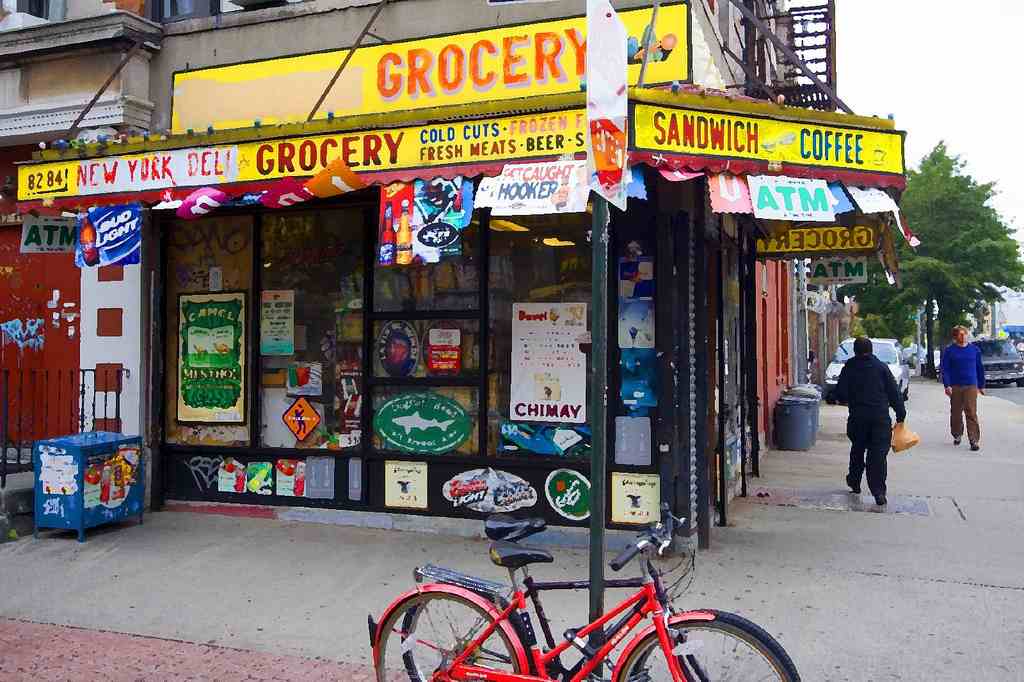
bodega-paul-smallThere’s a rush of righteous verdicts around an absolutely horrendous idea, concocted by 2 Google-twits, to replace real neighborhood bodegas around the country with automated kiosks filled with limited and generic items.  Its a bad idea from every angle, not least of which is that bodegas are the heart of the neighborhoods they find themselves in, filled with stories like this:
I was living on Grand Street in the Lower East Side of New York City at a time before it became fashionably hip and was still filled with the dark dangers of a city knocked off its center and careening like a broken top.  The bodega around the corner on Eldridge St. was the only light on, the only oasis that served up cuchifritos, beer, mystery meat sandwiches and “loosies” until 11pm.  After dark, the streets were deserted except for the sea of girls that appeared to ply their trade on the corners and the flotilla of New Jersey licence plates that circled them like sharks drunk on chum.  And yeah, the shop had a cat, maybe a few of them.  When its the neighborhood shop, they get to know their customers, their habits and their likes.  Mine was cheap, bad food, ice cream, cigarettes and beer at the time, and they had plenty of all of it: Coke and Twinkies and ice cream sandwiches and Budweiser chilling next to the Colt 45s, and the guys behind the counter could almost have the change ready when I walked in, I was so regular and consistent in what I bought late at night.  Most of the street girls knew I was local and we had a silent agreement that I wasn’t “dating”, so we would glide easily past each other in the aisles, each aware of the other’s presence while looking for a quick sugar or carbo fix before resuming our everyday cadences on the other side of the doorway.

cigaretteI was trying to quit smoking cigarettes so I decided to go the “loosies” route, hoping that the trouble and time it took me to get dressed, go downstairs and around the corner to buy a single Newport for a dime apiece (they were always Newports and I hated menthols) would be enough to deter me and break the habit.  Consequently, I visited my neighborhood bodega 5 or 6 times a day in my futile quest.
I’m in there one night and there’s two guys, a little tough looking, standing at the counter talking to the owner behind it in a semi-serious tone.  They notice my nod to him, my trip around the aisles looking for nothing in particular and then my approach to the counter.  “I’ll take 2 tonight” and he knocks two Newports out of the bottom of the pack, where, for some reason, he would always rip a hole right through the cellophane and foil instead of opening it at the top.  On my way out, one of two speaks to me.

“Hey, you live around here, right?”  This doesn’t sound good already and I’m on the defense.

“Yeah. So?”  A quick glance to the owner to get my bearings on this and determine my next move. And then the guy pulls his badge from under his shirt, mounted on a leather back and hanging from a chain around his neck.  He’s undercover NYPD and he’s on the job.

“So, we got a guy that’s doing bad stuff around the area, holding up bodegas, messing with the girls, bad stuff.”  I’m stopped cold and thinking things like ‘did I change my underwear’, ‘do my roommates know where I’m at’ and ‘do I even know a lawyer?’

“Yeah.  So?”

“Well, we think we have him, he’s at the station house.  He was robbing a store nearby.  And we have an eyewitness.  We need to put him in a lineup to make sure he’s the guy”.

“Oh, yeah? So?”  Because I’m so articulate when confronted with the possibility of jail time.

“Yeah, well, you kind of fit his description a little, he’s got bushy hair, he’s tall.  So we were wondering, would you be interested in being in on the lineup so we can pin him.  Don’t worry, it ain’t you, we got the guy, but we need to do this for the witness to make it stick.  We’ll give you five bucks”.

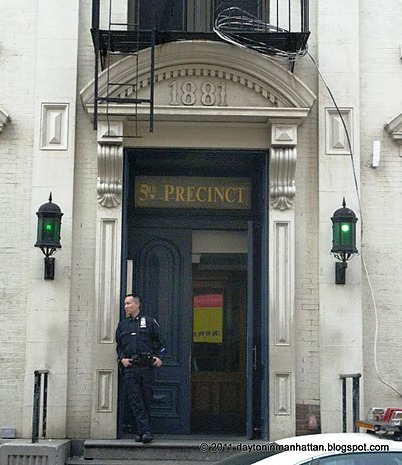
Suddenly, its a whole new ballgame and I light up.  I’m an experiential person, I like cop shows on TV, I’ve never been inside the deep end of a police station, all kinds of possibilities are open.  And this cop could be Serpico!  And yeah, five bucks, I’m a broke-ass actor in New York, subway tokens are still only 35 cents and a slice of pizza is a buck twenty-five at Ray’s.  This has some legs.  “Oh yeah? That sounds pretty cool, what do I have to do?”  And before you know it, I’m in the back seat of the unmarked car out front on my way down to the 5th Precinct on Mott Street in Chinatown.5th precinct

Its all amiable chatter with the cops, my new best friends, and we head upstairs to where the booking rooms are and I’m looking around thinking, “fuck, this is real live Barney-fucking-Miller in here”.  There’s a guy that looks like Abe Vigoda hanging around the water cooler, there’s coffee-stained cups on a table with packets of sugar lost in a white spray of spilled CoffeeMate next to them.  The walls are a dingy sea-foam green, there’s the smell of mustiness hanging from every chair merged with old coffee grounds and cigarette smoke and a sense of languid restlessness on the faces of every cop in the station.  I’m an actor: this is paydirt!

More small talk, I make a joke, one cop chuckles and I’m joined by other “volunteers” who kind of amble in with other cops over a period of 30 minutes and the truth is, we don’t look anything like each other, I mean one guy was short and blond!  But one of these guys is “the guy”, I’m thinking, and there’s a sudden rush of sanity that flows out of my ears for the first time: “what the fuck was I thinking?”  This could end up being some bullshit, New York at that time was a weird place, I have no idea what they could know about me and I have an big audition in 2 days…

police lineupWhen we’re all assembled, we walk into some narrow little room with only enough room for us to sit on small stools like we’re taking a crap (“what, we’re not standing? and where’s the lines on the back wall?”) and for fuck’s sake, I could be sitting next to “the guy” and I don’t see handcuffs on anyone and what the fuck is going on here?  But there’s the glass panel in front of us (with Jerry Orbach or Richard Belzer or Dennis Franz behind it) and we stare dumbly at it like we don’t really know what’s going on, but in the tradition of all lineups, no smiling, please.  And then we get up and leave.
All of us “volunteers” are kind of hanging around, looking around at the walls, trying to stay out of everyone’s way as the rhythm of the station keeps in time as if we weren’t there.  But we all want our five bucks.  We ask some “procedural questions” that we learned on TV much to the annoyance of the real police we’re talking to and its all pretty much boring and listless and we want to go home and we’re afraid we’re going to get stiffed.  But one of the cops comes up with an envelope and hands us either crumpled fives or a handful of ones and a low-moan “thanks” and we’re on our way out to the street.

The next night at the bodega I come in for my fix of two Newports.  The owner’s behind the counter, taps two out of the bottom, takes a quarter, gives me back a nickel, shakes his head and says, “you crazy, man”.

#bodegastories

Things Lost

On 9/11.

Just to show you what kind of a weird day it was, a day full of contradictions in the ether of the unreal, the tragic and the absurd: my sales team was looking to close a $1.2M technology deal with Morgan Stanley Dean Witter that morning at 9:30am at their offices on 50th and 8th Avenue.  Myself, my regional and national sales VPs and 2 partners from an allied technology in from Baltimore had gathered in New York City to make this happen.  We stayed overnight at the Sheraton on Broadway to finalize our close strategy and button up our final presentation. Early that morning, we were having breakfast in the lobby restaurant when Andy got a call on his cell phone from his wife about an airplane that hit the World Trade Center.  In our minds it was a weird event, maybe a Piper Cub that got lost (“didn’t something like that happen with the Empire State Building back in the ‘30s”?), but we were engrossed in the discussion of the upcoming meeting.  Suddenly, around us, other phones were ringing and looks of concern grew on the faces that answered them.  Neither the restaurant nor lobby had TVs mounted.  We paid the bill and were getting ready to walk over to the offices when utterances, phrases and words started to erupt from diners about “explosion”, “huge fireball”, “terror”. Then my wife called, watching it all on TV and relating it over my phone, which in those days, was just a phone.  She was upset and scared and worried.

We’re standing in the lobby of the Sheraton by the revolving door and it looks like any other day in the life of New York City: people making mad dashes, tipping doormen, catching cabs, conversing in groups, paying the bill, laughing, etc.  We realize something of importance and tragic significance has happened downtown but we have no idea what, there is no TV, no newsfeeds, but we’re all on phones getting different stories from the other end.  It’s around 9:15 and it’s a 5 minute walk and another 5 through the building to the 37th floor and a signed contract and time started to move very slow as we stood there, each of us pondering the same question in our minds as we felt the pressure of the tick of the clock and the enervating pulse of the conversations, growing looks of panic and increasingly rapid movements of those around us.  We paused briefly, which was an odd thing to do for 5 sales guys on the way to close a deal.  Finally, Kevin, our national sales VP, broke the silence, turns to me and asks the worst question possible: “Robin, it’s your deal.  What do we do?”

Snapped out of my own paralysis I suddenly realized what was at stake: we worked for a tiny technology startup out of Mountainview, CA, a company like many others that needed every single revenue source; I was the sole Eastern Region Account Executive and I guided this highly complex deal from its inception from a hot lead and through 3 competitors over 10 months to emerge with favored vendor status, which meant that we survived the competition and only pricing and services stood in the way of victory, two items we were clearly ready to be creative with; that this was Morgan Stanley Dean Witter and the prestige behind this win was huge beyond belief for the company; that I was about to be lauded as a superstar because of the way I brought the business in, not to mention the financial remuneration behind this for me; that I had my good friend, Andy who was my immediate boss, here with his good friend Kevin, who we all reported to and who ran sales for the company; that he, in turn, brought in the 2 partner guys from Baltimore as our aces in the hole; that I had just lost another large deal a few months before that hurt me and the company; that we all needed this win. 

“We’re going”, I said, and we took our briefcases, suits and ties through the revolving door, out into the clear, warm and bright sunny morning of September 11, 2001 and crossed Broadway towards Eighth Avenue to do business.

In the crosswalk over the avenue, one of the partners from Baltimore, increasingly agitated about being out in the streets, was asking me, “what are we going to say, what are we going to do there”?  Everyone listened in and I stopped.  “I don’t know what we’re going to say, I don’t know what we’re going to do; we’re just going to go there.”  Andy jumped in: “We have no idea what their state of mind is, what their expectations are.  We know we have a plan, we’re going to go in with that”.  And that broke open the silence and then the plans started to emerge as we walked, the strategies and tactics and contingencies and all the reasons why this deal should go through, and we pumped ourselves with confidence.  Traffic coming down 7th Avenue was heavy as usual with Yellow Cabs, thousands of people crossing the street, clogging the sidewalk, vendors with their kiosks and carts gabbing with customers.  It was suddenly normal, another day as we rode up the elevator to meet our Morgan Stanley contact, Stephen.

In the upstairs lobby we saw Eddie the guard, with whom we had fashioned a casual friendship during our many visits to the office.  Eddie looked at us, stone faced and asked “what can I do for you?” in a stone dead voice. The first sense of dread started to flow.  “We’re here to see Stephen, we have a 9:30”.  We never had to go through this formality before, it was weird and awkward.  I used to show up, Eddie would smile or at least recognize me and just say ‘have a seat, I’ll call him”; sometimes we would pass the moments with idle chat and there was always a smile with the goodbye as I left after a meeting. “Does he know you’re coming”?  “Well, yes…we have a 9:30.”  And with that, he disappeared through the door as we stood rooted into the carpet, unable to move, unable to talk.  Over the ceiling and around the walls a darkness began to creep over me; it filmed over my eyes, it ran down my head into my mouth and dried out my throat and began to burn my stomach.  We stood silent, unmoving, stone-like in our own personal sense of right and wrong as Stephen came out to meet us.

“What are you doing here?”, he asked and with that the world started to change in ways I wasn’t yet sure of, but the look on his face and the tone of his voice told me that nothing would ever be the same again.  “I…don’t know, we were all here…for the meeting…and…we felt we should just come over… .”   “Do you know what just happened?” he asked incredulously and as I stammered out a response he blurted out, “the Tower got hit.  The World Trade Center was hit by an airplane and our affiliate Dean Witter has the 2nd largest trading floor in the building and all our people were in it and the building’s been hit, it got hit by an airplane…it was terrorists…”   I started to respond, then we all chorused our shock, dismay, sadness, how sorry we were.  We offered help, assistance, support, we vomited words out into the lobby as a pathetic balm and because we were all businessmen, because we were all salesmen, because we were trained to kill and never lose sight of the win, we put together the shell of “next steps” as a way to navigate our minds through the dark fire of this most horrible reality.  Stephen disappeared back behind the door to the inner office and as we rode the elevator back downstairs to a new reality.

Still ignorant of the information that millions of others were witnessing live on television, we got back to the hotel and stood at the lobby doors, talking on mobile phones to loved ones and listening with the other ear to the flood of comments from those nearby: the 2nd tower had been hit, they were both on fire, they were large airliners, passenger planes, terrorists were on board.  We’re in a panic, figuring out an exit, how to get home, where would the next planes hit.  If this was a terrorist attack, then it still might still be going on and considering we’re in midtown, only one thing crossed my mind: the Empire State Building, which during the dark days of the Cold War and the Nuclear Watch of the Reagan era always stood out to me as Ground Zero in an attack, a spot where not only would the most damage be done but would stand as the most symbolic of targets.

We all heard the next piece of news at the same time: a plane has struck the Pentagon.  Kevin dropped his cell phone down and looked up: “Fuck, we’re under attack.  We’re at war”.  Not knowing what to think or where to go, not knowing if we should panic or proceed calmly somewhere – we still had not seen a TV – I guessed that if that were the case, they’re going to lock Manhattan down by closing the bridges and tunnels.  Before breakfast, we all checked out of our rooms, left our luggage with the bellmen.  Now we had to check back in indefinitely so that we’d at least have a place to stay to ride this out, even if we were just blocks away from a possible next strike.  We extended our stay at the front desk where the agents exhibited a strange, otherworldly calm about the entire proceeding, as if none of this were happening.  On the other side of their desk the world was all still about hospitality and efficiency and the number of keys you’d like to your room.

We decided to use my room as our base and on the way across the lobby to the elevators I dialed up my friend Keith who I knew had an office in Tribeca near the attack and whether or not he knew something.  I had one of those Nextel walky-talky phones and he was on speaker, standing on the roof of his building looking straight at the twin towers, flaming, smoldering, smoking.  He’s telling me people were jumping out of the windows, the constant sound of sirens in the back against the angst and terror in his voice. We’re all standing around my phone looking at each other trying to process this and just as the elevator door closed behind us he started screaming “they’re falling, the World Trade Center is falling, its falling” over and over and over “its falling”, then “I gotta go, I gotta go, gotta get home, get home, you get home, you hear me? Get home” and he went silent.

Back in my room, 90 minutes after it all began, we saw what the world had been watching from the beginning: the close-up of the remaining tower, burning alone on a clear blue background, not a cloud anywhere except from the smoke; the replay, over and over of the North tower falling, crumbling, belching smoke at it collapsed.  The endless replay of footage of the first plane, now available on newsfeed, crashing into the first tower, scenes of panicked people on the ground, covered in dust, moving aimlessly in every direction. 

Then, as the Baltimore guys made panicked calls on the room phone, talking to family; as I made plans with my wife to pick up our daughter from school and where I would meet them when I got back, assuring her I was alright, we saw the TV image of the 2nd tower, following the first, evaporating in mid-air; the stunned, panicked voice of the news announcer trying to maintain composure as he presided over an event more tragic and horrifying than one can imagine.  All 5 of us were yelling, shocked and horrified, with the one Baltimore guy pleading with his wife to stay calm as his face got redder with fear and frustration.  We were trapped in the false security of a hotel room, 7 miles away from Armageddon, one part real, one part a simple TV image and no one knew how to act.  Like the rest of the world, we were frozen in time, trying to understand and comprehend.

We were 5 adult men in suits and briefcases in a small hotel room, and the anxiety was so thick we were smothering each other, exacerbated by the panicky call the Baltimore guy was making. Finally, Andy pulled me into the bathroom and said, “look, I don’t know if this is my last moment on this earth or not, but those (Baltimore) guys are driving me fucking crazy and I’m not going out like this. We have to get out of here. We have to eat something, no matter what happens, we have to eat something.” And in a dumb haze over all that was going on, I instinctively said, “the Carnegie Deli is up the street, let’s go there.” And so we pulled the Baltimore guys away from the TV and the phone, got in the elevator and out into the street. 

Broadway at that point was blocked from traffic, empty, eerie, the bright sun overhead. Now, the first of the “walkers”, the eye-witnesses at the site, covered in dust and ash, were making a slow, zombie-like shuffle up from their origin point downtown, miles away. Men and women with jackets off or around their arms, holding shoes and pocketbooks and briefcases, heads down, exhausted and beaten, moving north up an empty street.

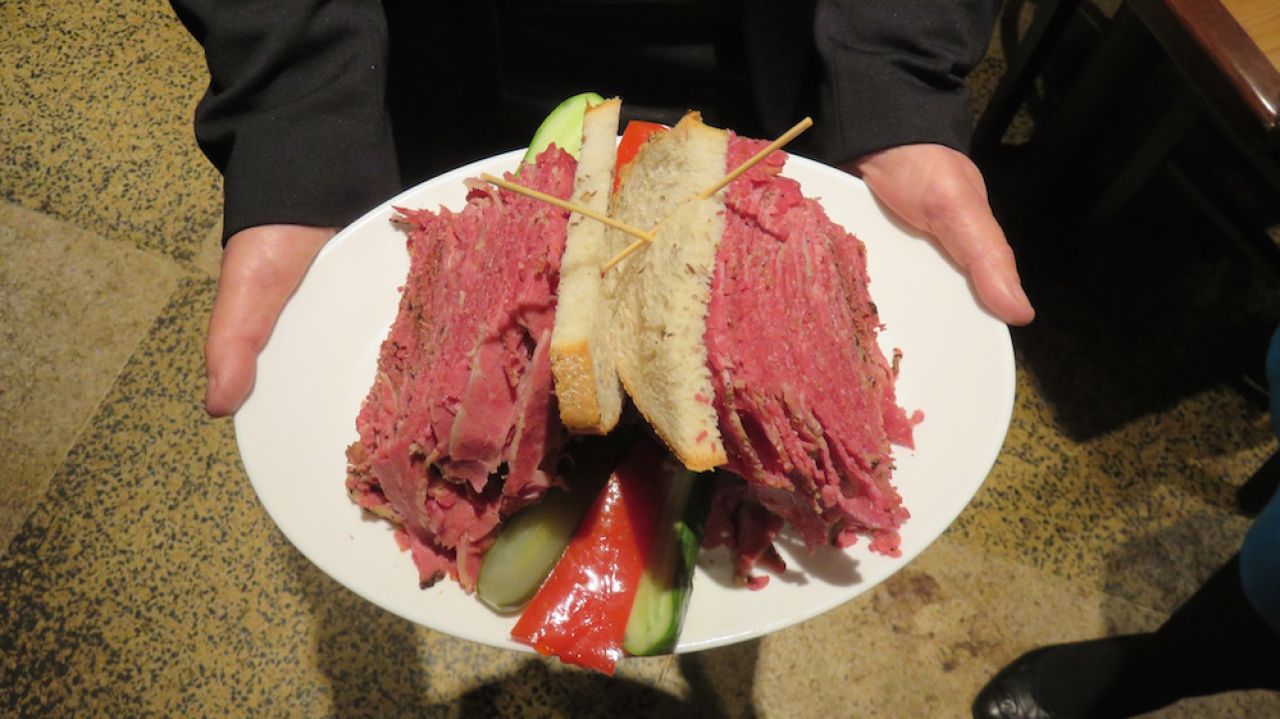
Here’s what a lot of people don’t know about New York City: at any given moment, it exists on several different geometric/time planes, it’s so dense and so massive that multiple events occur and overlap each other with a juxtaposition that can be sometimes unnerving and jarring, other times amusing and surreal.  The stream of workers passed by a sidewalk café next to our hotel and there sat a young couple, oblivious to what was going on, smoking cigarettes and drinking mimosas.  So when we opened the door of the Carnegie Deli, coming from the sunlit, empty fearfulness and panic of Broadway there was no way of knowing we would enter a darkened, lively, noisy and buzzing environment. Deli workers were cutting and serving meats behind the counter; waitresses and busboys cutting in between tables with arms full of platters and water tumblers. People were talking, there was some mild, personal laughter between some, waitresses were calling “honey” this and “sweetie” that, taking orders, cutting sandwiches, wrapping the rest, asking for more Coke, clearing tables, all the sounds and feelings of another day in pastrami paradise surrounded by TVs mounted on walls that showed a smoking ruin where tall buildings once stood. No one was really sure of exactly how many people died, we had no way to assess what we now know as the cruelty of that day. I actually was very hungry and I finished that corned beef. It may have been the best sandwich I had ever eaten.

How surreal, the tiny crumb of normalcy that everyone in that restaurant forged with each other out of a pure human need to make a small connection in the face of enormous fear and tragedy. Both the WTC and Carnegie were world famous icons; the towers gone now for 20 years, and the Carnegie now empty for 2. I can get a good pastrami in a lot of places, but I don’t think many can deliver what that deli did that afternoon.

pastrami

We made a new plan: get across the river to New Jersey. Andy and I lived there; Kevin, from California, could stay with Andy and the Baltimore guys could rent a car to get back. We would go back to the hotel, grab a cab and, hearing that the Hudson River bridges and tunnels were closed, would steer over to the Bronx and head north until one of the other upstate bridges were open. We would cross over and come back south to New Jersey to get our cars, and where the Baltimore guys could get the rental.  On our way back to the hotel, we saw a limo sitting at the curb, and in another one of those two different planes of reality moments, the driver was purchasing black socks from a corner street vendor.  In the middle of this disaster, one needs to be well dressed.  One of the Baltimore guys approaches him, they talk for a moment and he turns to us to say, “get in”.  He struck a deal: $500 in cash up front and $1000 on his American Express for a ride back to Baltimore, dropping us off in Teaneck for our cars.

We headed uptown and over to the FDR with the intent of crossing the Willis Avenue bridge to the Bronx over the East River.  But the driver heard on the radio that the George Washington Bridge had just reopened, so we kept going to the east side approach to the bridge.  This would be easier than we thought, and I made a quick phone call to my wife to let her know I was coming home soon.  As we spoke, we crossed over the upper level span of the bridge. I looked south and dropped the phone down.  On this bright, blue, beautiful, late summer day, at the tip of Manhattan in a view I took for granted just the day before, the twin World Trade Centers were gone, replaced by two white clouds that were being pulled by the wind over Brooklyn.

May we never forget.

Robin Robinson
September 11, 2XXX