 I don’t have a problem identifying myself as a Christian. I was born into the Church and though I’m not as active as I used to be, I foresee a time in the future when I will exit through it as well. I was brought up to understand the impact that a loving and forgiving God had in my life. Throughout it, especially in times that were both the most challenging and the most rewarding, I have called upon Him in thanks, desperation, need and celebration. Most people who know me have heard nary a word of this coming out of my mouth because I was also brought up in a tradition that doesn’t see a need to throw it out in people’s faces when they’re not looking for it. Faith and belief are personal issues and I do thank God that I had a family around me when I was young that imbued a sense of personal responsibility and character along with humility, forgiveness and repentance. And my immigrant grandmother who made sure I went to church every Sunday.
This is why I have such a problem with “Christians” today. Throughout history, they have failed humanity, themselves and their God in the name of Christ, or Jesus, or The Savior, or whatever moniker the latest sect chooses to identify Him. For the most part, they feel justified in doing so. And right now, they’re really pissing me off. Especially the American ones.
I grew up as an Eastern Orthodox Christian where faith is a choice; correct actions are a choice and we were born with free will to decide how to behave. We also learned that as humans we are fallen creatures and our failings are the essence of our humanity: we sometimes make bad choices and finding grace in one’s life is the recovery from them. This concept was supposed to bind us together, this knowledge that we all fail, we all have weaknesses, but we would have this common faith in God and in ourselves to lift each other up. It is the essence of what it is to be human. But the Christianity that I see and hear in the national conversation is not the one I recognize; this one takes the position that we are kings of the universe and have an inherent right to force our beliefs on others, that “choices” are directed by God or Satan. That our failings have been thrust on us from afar, that we are constantly under attack and must be ever vigilant to fend off the evil that can corrupt us. This interpretation is what the the holy fathers of my faith would call an abomination, a heresy and my good friends outside of Christianity should take heart that these are not the central tenets of the true Christian faith.
The exercise of faith is a choice. You may be born into a faith and it may be bestowed on you by your family, but how you behave in that faith is your choosing, and following it means choosing to do so. No one, particularly Jesus or Satan, are forcing you to make the choice. You are responsible for your own actions against others and when those actions take you away from the path God has laid out in the teachings of the Old and primarily New Testament, you must find a corrective course to take. Primary above all is the directive to love one another above oneself. If you’re looking for the real meaning of Christianity, this is it. A sin against mankind is in reality a sin against God.
This is where the concept of obedience enters. While I’m not going to get into a theological debate about what obedience means, let’s just say that its a virtue and an excellent placeholder for other forms of preferred behavior like respect, honor and fealty. This is as instructional in the governing of our behavior as the ancient myths of Olympus were to the Greeks: in every society on Earth since the dawn of time, something like “religion” has been created to codify behavior between ourselves, and the desired effect is obedience. You only have to ask yourself “why” to come to an understanding that we as a species know that we are prone to failure to another and as a community, we’ve formulated ways to keep ourselves moving forward in time. In Christianity, our job as the faithful is to use our limited time on Earth to get back to God when we “cast off this mortal coil”; for each of us individually to follow the path that His Son has laid out in those few years of teachings that had been revealed to us as our new covenant, or agreement, with God. Therein lay the irony, because this covenant, The New Testament of the Bible, was written down and interpreted by flawed humans hundreds of years later. (And wait…it was not translated into English until the 16th century!). This gets to the heart of my argument and it is the one that anti-Christian writers consistently use to challenge the core tenets of our faith: if the Bible is the “word of God”, and humans are so inconsistent and petty, how can we trust anything they’ve “written”? How can you base a faith that has been at the heart of some of the world’s worst atrocities, that has been spouted by some of humankind’s worst offenders and used as a justification for bad behavior against ourselves?
My faith is theologically complex but simple in execution and understanding: Jesus was both God and man, he was born to a mortal woman and lived through our mortal life and our limitations, failings and temptations to show us the way back into his Father’s house. In this way, Christ is us. We do dumb, stupid things; we choose to succumb to evil; it is in our power to make the morally and ethically right decisions and we choose not to. There is no “the Devil made me do it” about it. But the Christianity I read about on the web and listen to on TV justifies every failing by twisting the virtue of forgiveness and repentance, turning the love of God and the force of evil into something anthropomorphic, each tiny being perched on opposite shoulders in a tug-of-war for our souls: angel vs. devil. And by doing so, by creating this tangible division, it becomes all the easier to assign those roles to the others in our lives, those around us, those who affect in ways real and unreal. The real essence of these twin forces, right and wrong, is to bring to front of mind the wrongness of our chosen acts so that we can make the correct choices, to not repeat the wrong ones. It is not about layering guilt on someone, casting them into the abyss, condemning them to eternal fire as a way of punishment. Nor is it about promoting unrealistic assumptions of one’s goodness, creating demi-gods of unimpeachable integrity and saintliness, people who’s feet do not touch the ground but hover slightly above it so as not to dirty themselves. Jesus himself wore rags and his feet were caked in dirt. The lesson is about the acknowledgement that that both forces are within us, the power of good and the destruction of evil; the instruction is in helping all of us, who choose to believe, to lead a better life for ourselves and others by not repeating our failures, and understanding that we may. In doing so, by placing the good of others above ourselves, we have followed in the steps of Jesus the man as he became the Christ, the mortal incarnation of the God of Abraham. By failing again, we acknowledge that there is still wisdom to attain in how we lead our lives and that perfection can only be attained at the end of it with His help. Jesus’ act of sacrifice, of giving himself over for us, is why we are Christians, an acknowledgement that are weak and our acceptance of this is our humility. When we are humble, we seek to help others, not ourselves.
Or we should be. What I see daily is a faith being hijacked, transformed, diluted, bastardized, and mutated into a gospel of individualism, power, greed and dare I say it, pure evil. If a faith is based on the acknowledgement that we are formed with 2 natures, one of the earth that is destined to age and rot and come to an end; and one of “heaven” that is pure and immortal; then its inherent within that teaching that many of us will make the choice to fulfill our earthly destiny at the expense of our heavenly one. This is the inflection point of our faith: once we’ve chosen the wrong path, how do we find our way back to the correct one.
When you compare Christianity with every other religion on Earth, the paths are startlingly similar. Buddhism, Sikhism, Islam, Judaism, Hinduism, the teachings of many aboriginal and locally nativist faiths as well, all follow similar tenets. Love others, treat each other as you would have them treat you, be of service. These are not solely Christian or Abrahamic concepts, they are universal. Those without a chosen faith, whether atheist or agnostic, will find themselves on a similar path if they choose to be so, as these truths are self-evident in what Immanuel Kant called “moral imperatives”.
But there is a strain of Christianity that is uniquely American that is perverting these ancient beliefs. It comes out of the Scottish kirks of the 15th and 16th centuries that were caked with the harshness and unforgiving nature of Calvinism as a reaction to Anglican overrule from English kings; it was molded by the secular clashes in Northern Ireland in the 16th and 17th centuries that culminated in the antipathy of Protestants and Catholics. It was brought to America by the Scots of the Ulster Plantation of Northern Ireland, known as the Scots Irish, the largest ethnic migration of the Colonial era and forged in the harsh mountains of Appalachia and Allegheny. It was mixed with the Protestant Baptism of English settlers in the south and fueled by the guilt of human bondage in a slave-driven economy. It is founded on a patriarchy that is a perverted reading of the Old Testament and shaped by the irrational emphasis on the Apocalypse of John and the Second Coming. It believes in individualistic self-determination as if it were one of the Ten Commandments and interprets Jesus as if he were a hard-bitten, vengeful entrepreneur wearing buckskin and beaver pelts carrying a Winchester rifle through the Cumberland Pass.
Its early field interpreters were Charles Taze Russell, Aimee Semple McPherson, Billy Sunday, Fulton J. Sheen, Jerry Falwell and Billy Graham, each latching onto a part that allowed their own personalities to shine, to be the individual interpreters of the message of Jesus; its apostates were Jim and Tammy Faye Bakker and Jimmy Swaggart, each caught up in scandals; and its perverted extremes were the demi-gods David Koresh and Jim Jones. Its present day incarnations run from Pat Robertson and Joel Osteen to James Dobson, Tony Perkins, Charlie Kirk and, God help us, Pete Hegseth. Thousands of self-appointed interpreters of the Word of God preaching in city storefronts and rural gatherings, huge mega-churches and TV ministries. Each one of them preys upon the disjointedness of the modern condition of alienation and uses Christianity as a vengeful weapon against their own perceived injustices. This is not Christianity. From the perspective of eons ago, this would be considered “heresy”. And it would have been condemned.

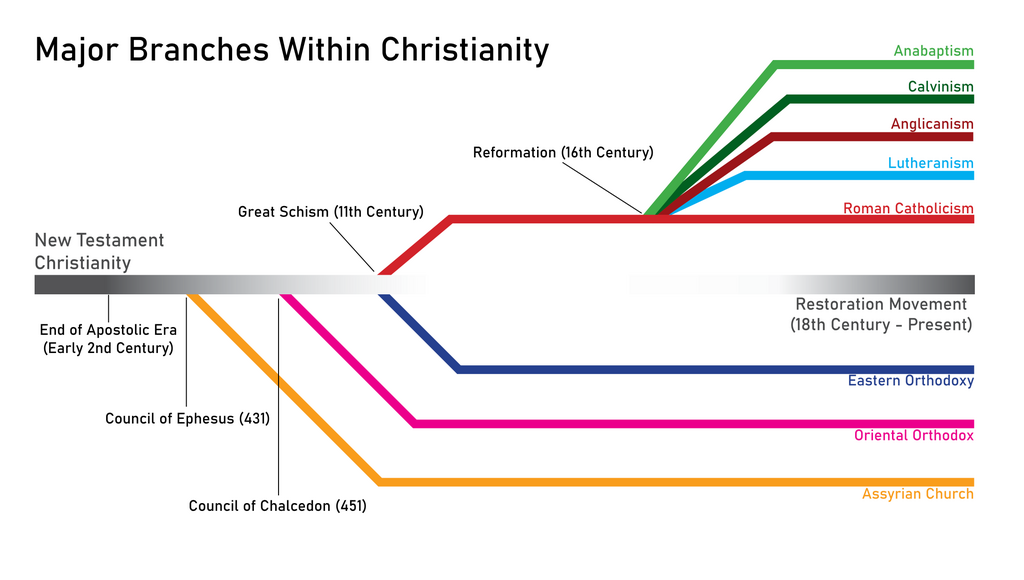
What happened is that the Protestant Reformation broke the hegemony of a centralized authority, the Holy Roman Church. The Roman Church itself was born of the Great Schism of 1066, where the Bishop of Rome, the self-proclaimed “il Papa”, got into a dustup with the heads of the other 4 Christian autonomies (Constantinople, Alexandria, Jerusalem and Antioch) and ex-communicated them. Thus Roman Catholicism was born in the West, and it cast its eye away from its Eastern peers, derisively known as “orthodox”. Aligned with imperial power (starting back with Charlemagne), the Roman Church had a love affair with itself as an imperial power center, ruling all of Europe and Western Russia. Its as if the Church was staring at its sole image in a mirror for 1000 years. At the Reformation in the 15th C, the mirror fell and broke into a thousand pieces. Now there were a thousand variations of that reflection, depending on who picked it up. Instead of the unified and communal (and yes, corrupted) practice of faith, testament, interpretation and redemption, each individual got to make those decisions individually and chart their course as they saw fit. They inherited their own personal God/Jesus/Messiah/Christ, and they shaped Him into their own image, not the other way around.
As the new wave of immigration from Europe poured into the new world of the Americas in the 17th, 18th and 19th centuries, these individual interpretations of Jesus/Christ/God (including the Catholics from Spain) formed alliances, rivalries, mergers, and antipathies, many morphing further from what actually was outlined in early Christian texts.
This particular map below is but a simple org chart of what followed:
But wait…there’s more!
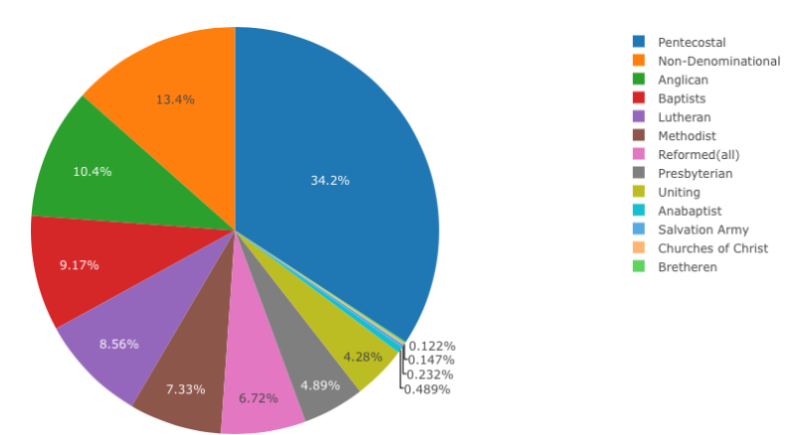
Each of these faiths made their way into the settlements, then the wilderness of the new world at a time when literacy was still nascent and inconsistent. In Europe, the monks of the Holy Roman Empire were the learned ones who spent centuries decoding ancient Arabic texts into Latin, then to other Proto-Indian languages and cultures. They took the early texts of the Christian faith (codified by 7 Ecumenical councils in the 5th and 6th Centuries) and created a unified view of God. The Church during that time held great power as a result. After the breakup, as Protestant and Anglican sects formed and re-formed in the new world, the individual clergyman, typically the only literate person on a grueling cross-country caravan, continued to hold the keys to power and persuasion. The only respite many of these hardy folk had, in the face of starvation, weather, tribal raids and disease, was the Word from the Good Book spouted by this lone interpreter. Because he was “inspired”, “touched by God”, “imbued with righteousness” and “prophetic”, his leadership, and his interpretation of “scripture” was inviolate. He was to be obeyed. When you’re out on the prairie, constantly beset by survival challenges, you can see where that can lead.
This is the American heritage of Christianity: filtered through individual interpretations, each one its own revelation. This is why there is so much spouting of passages from the Bible as justifications for bad behavior. When I take a passage out of its original context – a passage that in and of itself is a proscription for whatever behavior I am experiencing – I can then, in essence, write my own Bible: the Book of Extracts. When you look back at the examples I listed above of “prophets” and “seers”, it becomes evident why Christianity in America is not about Christ or Jesus, but about the interpretations of them by the inventors of neo-Christianity.
Here’s another chart to give you an idea of the impact of the “individual” :
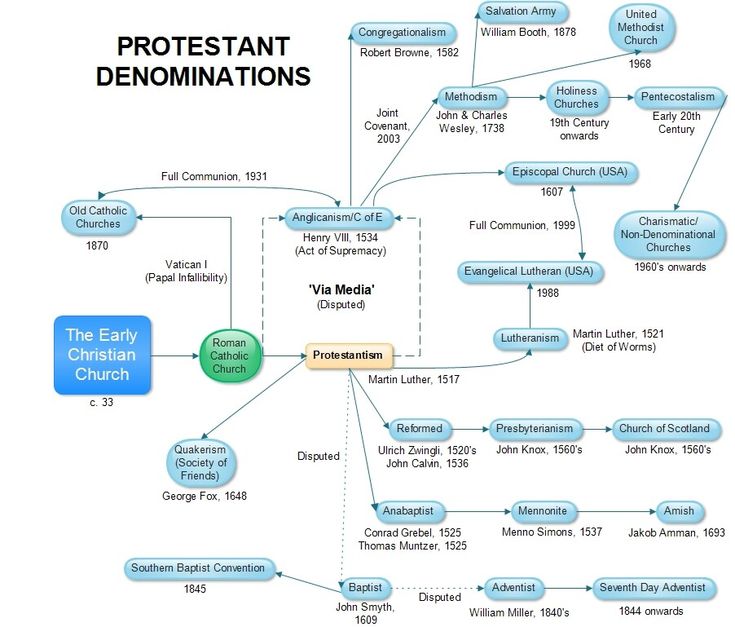
All religious faiths on Earth are human creations. Each one emanates from mankind’s eternal quest to understand the unknowable, to probe the mysteries of the human condition and natural conditions. Throughout history, each of the beliefs went through a codification, in which behaviors, attitudes and comportments were agreed upon and set into laws by other humans of a similar mindset. Each “founder” claims a secret connection to another world; a private whisper from a divinity. Many of their adherents and advocates claim a “divine” inspiration, something that can never be proven, assessed or measured. During the days of the Holy Roman Empire, that spark was never individual, it was communal and passed on through a series of learned proscriptions that brought you to a specific place in your life where you were “worthy” to receive it, watched over and coached by your learned elders. But the Reformation obliterated that hierarchy. Now, if you are walking along a road alone and come upon the “the spirit of Jesus” and He hands you some golden tablets and tells you to start your own church, the only thing holding you back was your ability to convince others of your “truth”. The next thing you know, you’re in a circle with others of the same mindset praying over a misogynistic, psychotic, convicted felon and serial liar and proclaiming him a Message from God.
And that, my friends, is American Christianity.
 Bile
Bile 